

How Sucking at Blackjack Taught Me a Fundamental Body Language Lesson

‘How accurate is body language reading?’ is a question I get all the time, and the correct answer has a lot to do with how to beat the house at blackjack.
This is a major concern for anyone aspiring to become a human behavior decoder. How exactly do we know for certain that what we are reading is, most important than anything else, accurate?
This is one of the main arguments of the ‘body language is a pseudoscience’ horde. Their misguided claims are based on the ad-nauseam-parroted argument that, since you can’t reduce human behavior to a formula, or a single algorithm to process every possible scenario, then decoding intentions by just looking at people is on par with reading chicken bones rolling inside a bowl.
And this is wrong for many reasons, that might or might not include chickens.
In reality, when we talk about how accurate you can become at reading body language, the first thing that should come to mind is blackjack, especially card counting.
Just in case you don’t know what blackjack is, it’s a card game in which you play against the dealer to see who gets closer to 21 with your cards without going over. That’s pretty much it! Now you can head to Atlantic City and lose your entire retirement in less than it takes to watch a Peppa Pig episode.
But now you need to know about that time I stumbled upon…
The VHS tape that got me into card counting
I’m sure you remember those times when we used to rent VHS tapes in Blockbuster Video. Maybe you are more or less my age or maybe you’re younger, but I used to go there to rent movies. I think it was the Mesozoic or Paleozoic era. Can’t remember. Writing hadn’t been invented yet.
After getting tired of both blockbusters (pun intended) and b-movies, I remember roaming the shelf of documentaries and general guides. For a curious dude like me, those pre-Encarta-Encyclopedia dark ages were a godsend. Multimedia CD-ROMs, and let alone the internet, were still a DeLorean trip away in the future.
On one of those trips I spotted this tape that was about blackjack, aptly named ‘PRO BLACKJACK winning techniques’, and took it home. Two hours of solid advice about how to play blackjack and how to make sense of all the possible card combinations that you should keep in mind to not make a fool of yourself at casino tables.
But it had a very interesting chapter on card counting, and how card counting was the actual way to beat the house’s odds.
Contrary to what you might be thinking, when we talk about ‘card counting’, you don’t need to do fancy calculations in your head while playing. In fact, it’s so simple that I’m pretty sure a chimpanzee could do it. Hell, even a liberal could have a shot!
It works like this: You start with a number ‘0’ in your mind. Whenever any card is dealt for anyone in your table, you either add or subtract ‘1’ to that brain-jelly-powered count. More specifically…
If the card value is anything from 2 to 6, you add 1 to your count
If the card value is between 7 to 9, you do nothing
If the card is 10 to A, you subtract 1 from your count
What you’re doing with this is trying to predict the average value of the cards remaining in the machine, assuming of course that the machine has a standard distribution of card decks, which is something enforced by law. Depending on the number that you have in your mind, you hit (ask for another card) or stand (stop receiving any more cards).
That’s pretty much it.
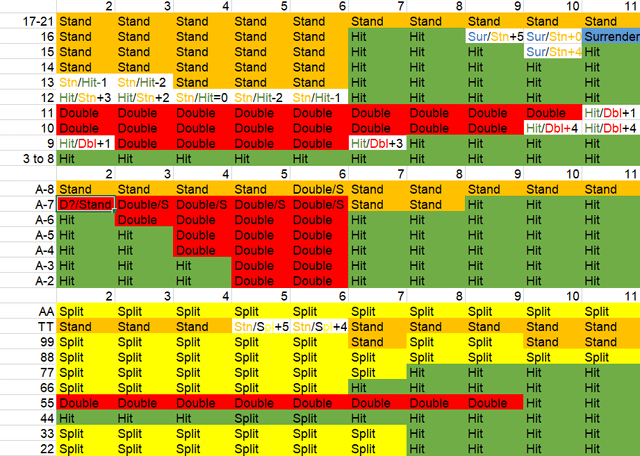
TL/DR counting cards can literally help you beat the house, and this has been proven time and time again. In turn, the casino manager will politely invite you to play any other game *but* blackjack from that point on.
But before you risk getting your legs broken at the casino’s parking lot, we need to understand the concept of odds.
Yes, you can actually beat the house at blackjack, but you’re not gonna win every single hand that you’re dealt. That simply won’t happen. Because last time I checked, neither of us are Dustin Hoffman. And if by any chance you’re Dustin Hoffman, I loved you in Wag The Dog.
Anyway, I digress. You will not win every hand that you’re dealt, but you will win enough of them to make a profit. Does that make sense?
In the end, given enough instances, you’re gonna win.
IF you play enough times, you will have the odds stacked in your favor.
And that’s the idea that I want you to understand about body language reading. The more ‘cards’ you count, the better informed you are.
The difference is that in this case we’re not counting cards but observing postures, hand gestures, face expressions, head tilts, voice tones, breathing patterns, feet angles, blinking rates, you name it. Yes, it can be overwhelming but I’ll give you the exact ‘order’ in another article.
The principle is the same: the more factors you observe, the more information you have, and the sharper and more accurate your body language assessments will be.
I hope that the ‘body language is a pseudoscience’ horde understood this. Because yes, we’re using a statistical approach to reading human behavior. And I’m pretty sure statistical approaches are still approved by the scientific community to do, you know, science stuff.
With this approach to people reading, you’re gonna win many more times. Granted, this will always be more complex than just counting cards and hitting or standing, but on the other hand, definitely more fun.
This journey is like a Zelda game. We’ll unlock treasure chests progressively, cramming our inventory with all sorts of items and weapons; and every single one of these ‘reading skills’ we uncover raises our Decoding XP. I’d call it DP, but better not. Bad idea.
So, no, there’s no ‘The one facial feature or gesture to read them all’ that allows you to know if someone is lying. In fact, that’s one of the main gripes of the Body Language Deniers. You’ll see headlines like “STUDY: FACIAL EXPRESSIONS CAN’T PROVE IF SOMEONE IS LYING”, and you wonder why sites like Business Insider and Buzzfeed haven’t gone the way of Geocities. Because that statement is like saying “STUDY: EATING ONLY CHICKEN NUGGETS WILL MAKE YOU A YOUTUBE ESSAY”

Because it’s a non-argument. Body language reading has never been about ‘this ONE signal’.
No, you can’t guess behavior from just facial expressions. Or voice tone alone. Or the shape of someone’s bellybutton. You need to account for a number of other factors, including (shocking news!) what people say, which is obviously not nonverbal communication, but it’s part of the whole package.
Now, pretty much the same with Blackjack, you’re not going to ‘win’ every single hand you’re dealt, because…
Sometimes you’re going to get it wrong.
When it comes to deciphering body language, you’re going to mess up sometimes, no matter how many factors you read. And that’s ok! You need to give yourself permission to fail, even if you’re years or decades into this. You’ll never be 100% sure, but a 80% is a good deal in many, many scenarios.
And I haven’t mentioned one critical point: We’ve been talking only about ‘passive’ observation. As in, you’re detached of the event itself, or you can’t influence it in any way, like analyzing a video. But if you are reading a person who you’re talking to, this changes dramatically: because you can assess their reactions to your questions and statements, and this can take your accuracy well over 90% in a few turns.
(That is, if you know how to ask the right questions, which I’ll address in a future post)
That’s why we need to talk about critical thinking as well, in order to figure out people’s behavior. Because it’s not only observing, but elaborating hypotheses of where their behavior comes from, and what are their intentions, and how involved are you in those plans.
There’s no “Let’s use this one simple trick” No, that doesn’t work like that. If you use ONE simple trick, that simple trick will most likely fail 50% of the time. But if you add 10 or 20 ingredients to your behavior analysis soup, your assessments will only be richer and smack dab in the middle.
So, this is how body language reading works! Like card counting in blackjack. Sometimes you will get it wrong, especially if you use few or just a handful of tools, or you’ve counted just a few cards or played a few hands. But the more tools you use, the more tools you learn and the better your readings will be.
If you want a guide that includes all these tips and more to help you learn body language reading progressively, I suggest you grab a copy of my book “Body Language in 40 Days” here: https://www.amazon.com/Body-Language-Days-Step-Step/dp/B0991C7ZPN/
Much Love and Bliss,
Jesús Enrique Rosas
The Body Language Guy.
Jesus, I love your writing! You are absolutely hilarious, and always thought provoking. Don’t stop:)
Would you ever consider doing an audible version of your book? I think listening to your insightful and humorous commentary in your own voice would be marvelous!