

The Most DISTURBING Narcissist Tactic NOBODY Talks About

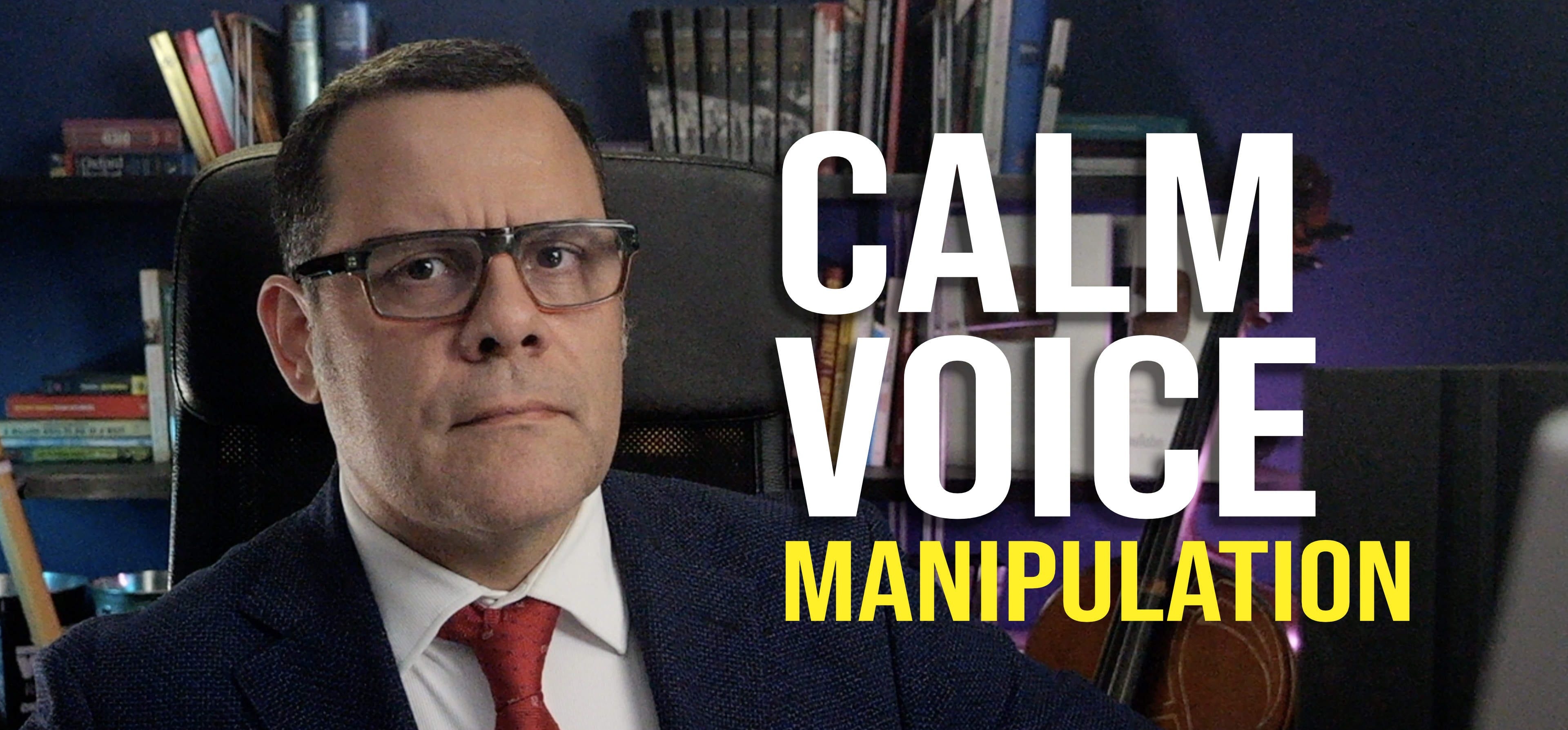
There’s something you need to know about narcissists. They don’t break you by yelling. They don’t need to. They break you by going completely still, while you’re falling apart. And that manufactured composure? It’s one of the most effective manipulation tactics you’ll ever encounter.
But once you understand the body language signals behind it, the whole strategy falls apart. And you’re about to see exactly how.
If you’ve ever walked away from a conversation feeling like you owed someone an apology for having feelings, even if YOU were the one who got hurt, you already know this tactic.
You just didn’t have a name for it.
But Here’s how it works. You bring up something real. Something that genuinely hurt you. And instead of any kind of emotional response, such as defensiveness, guilt, concern, anything... he goes calm.
But not the kind of calm that means he’s actually listening. We’re talking about a manufactured composure display, and their intention is to make your emotional reaction look disproportionate by comparison.
And it works! Because the calmer he gets, the louder you sound. And the louder you sound, the easier it is for him to lean back, tilt his head in that clinical observation posture, and then say:
“I think you should talk to someone about this.”
Now you’re not discussing what he did. You’re defending your own sanity. That’s not a conversation.
That’s a trap.
Now, all this sounds a bit abstract, so let me put you inside...
A REAL EXAMPLE SO YOU CAN LEARN TO SPOT WHAT’S GOING ON.
You’re in the car after a dinner with friends. A good dinner. He was charming, everyone loved him. But the moment the car door closes, he says:
“You know everyone noticed how much you were drinking tonight.”
And... yeah, it’s an odd way of speaking because it sounds like halfway between an affirmation and a question.
But anyway, it makes you think. You had two glasses. Same as him. Same as everybody else. And you say it,
“But... I had two glasses, just like you, just like our friends”
But he acts like you just spoke nonsense. And most likely he’s gonna do this slow exhale through his nose, controlled, deliberate.
That nasal exhale is a manufactured composure signal. It’s designed to communicate disappointment without giving you anything to push back against.
“Okay,” he says. “I’m just looking out for you.”
And then... nothing.
Silence.
But not neutral silence. This is a loaded silence. The kind that sits between you like an accusation waiting to be answered. Because there’s an unresolved argument lingering in the air.
So you react and make your point again. Because you’re a human being and you can feel it pressing against you.
“What do you mean? I had two glasses, same as everyone.”
So that’s when he gives you the half-smile. Not a real smile, but a contempt micro-expression: one corner of the mouth pulls up while the rest of the face stays flat. Because he was expecting you to react.
“I didn’t say it was a big deal,” he says. “You’re the one making it a big deal.”
And this is what you don’t understand. You got in that car feeling fine. Ninety seconds later, you’re replaying the entire evening in your head. Counting glasses. Wondering if your laugh was too loud. Questioning your own memory of a night you just lived through.
He didn’t raise his voice, not even once. But he didn’t have to. He got you to do the work for him. And this is exactly how you can spot this pattern, when someone’s body language is incongruent with the emotional weight of the conversation, and that weight is NOT marked by arguments but by a condescending silence, boy... that’s a huge red flag.
HERE’S WHY YOUR NERVOUS SYSTEM FALLS FOR IT
Here’s what’s actually happening beneath the surface, and this is absolutely critical if you want to recognize manipulative personalities.
Emotional conversations, and conversations in general, are supposed to be bidirectional. When someone you love tells you “that hurt me,” the normal human stress response involves some level of emotional activation.
Concern, guilt, even defensiveness.
Something. Anything!
What the narcissist does is remove his emotional signal entirely. He flatlines. And your nervous system does not read that as calmness. It reads it as a wall. As absence. As danger.
So you escalate. Not because you’re irrational. Because you’re trying to reach someone who has deliberately made himself unreachable.
You’re knocking louder on a door because nobody’s answering. That doesn’t make you aggressive. That makes you someone standing outside a locked door.
But the problem is that this is a fool’s errand. The louder you knock, the more he hides. And that gap, between his artificial composure and your distress, becomes the only evidence he will ever need.
He doesn’t have to say you’re unstable. The contrast says it for him.
YOUR emotion IS his proof.
AND THAT’S HOW HE TRAINS YOU TO GO SILENT
This is the same pattern when you try to set a boundary and he says “I hear you” in a voice so flat you KNOW he didn’t hear a word. But what are your options? Repeat yourself with more intensity? no! because now you look obsessive. But if you drop it, now you have surrendered your position.
Either way, he wins.
It’s the same thing when you catch him in a lie and he doesn’t flinch. He just pauses, looks at you with complete stillness, and says:
“That’s... not what happened.”
As if you’re the one who’s confused. And because his body language displays zero stress indicators, no rapid blinking, no fidgeting, no jaw tension, nothing... some part of you wonders: am I the one who’s wrong?
“Am I going crazy?”
And it’s the same thing when you finally break down crying after months of this, and he sits across from you, arms folded, which is a classic emotional barrier posture, head at that clinical observation tilt, and says:
“I don’t know what you want me to do when you get like this.”
Pay attention to those words. “When you get like this.”
As if it’s a condition.
As if it just appears out of nowhere.
The worst part is that this compounds, and this is why this does real damage. Over time, you stop bringing things up. Not because the problems went away, but because raising them costs more than carrying them. Every time you try, you leave the conversation feeling worse than when you entered it. You learn that having a need is a liability. That expressing hurt leads to being examined.
That crying leads to a performance review.
So, you learn to go quiet.
And your silence? That was always the endgame. A silent partner is a controllable partner. The calm voice was never about winning an argument. It was about training you to stop having them.
BUT HERE’S THE ONE SENTENCE THAT BREAKS THE MACHINE
What do you do when the calm voice shows up?
You do the one thing he’s not prepared for. You refuse to be the loud one. Not by suppressing yourself. Not by going numb, but by saying one sentence that makes the entire performance visible.
When he flatlines and you feel that pull to escalate, to explain, to prove, to raise your voice, you stop. You take one quiet breath, and say:
“I’m not going to compete for who seems more reasonable right now. I said what I needed to say.”
Then you stop talking. And I mean, you don’t open your mouth again.
NOT as punishment. NOT as a power move. But because you want the pattern to stop. Because you are done performing for someone who’s grading your emotional response.
Here’s what will happen. He’ll pause. He might try the half-smile, the contempt micro-expression. He might say “I don’t know what you’re talking about.” But the dynamic is broken, because manufactured composure only works as a contrast. It needs YOUR emotional activation to look composed.
Without that, it’s just a man sitting in silence with nothing to point to.
The moment you stop trying to reach him, his composure has nothing to push against. And a weapon without a target is just a man holding something heavy for no reason.
Remember what I said at the beginning: that narcissists break you not by yelling, but by going still. Now you understand the body language signals underneath it. The head tilt. The contempt display. The folded arms. The deliberate flatline.
You can spot these cues. You can recognize the pattern before it locks you into the cycle. And once you see the mechanism, it can’t work on you the same way again.
You were never the unstable one. You were the only person in that room actually feeling something.
That was never your weakness.
That was always proof you were still intact.
Now I’d love to read your thoughts in the comments — have you experienced this? What was the moment you first recognized the pattern? Let me know.
And if you want to become truly immune to manipulation, book a call with me here.
Much Love and Bliss,
Jesús.
The Body Language Guy
.....And then get away from him for good!
Goodness ! Yes ! Ive been subjected to the narc calm voice tactic!!
Its quite awful. When they tell you or others that you are the crazy one!